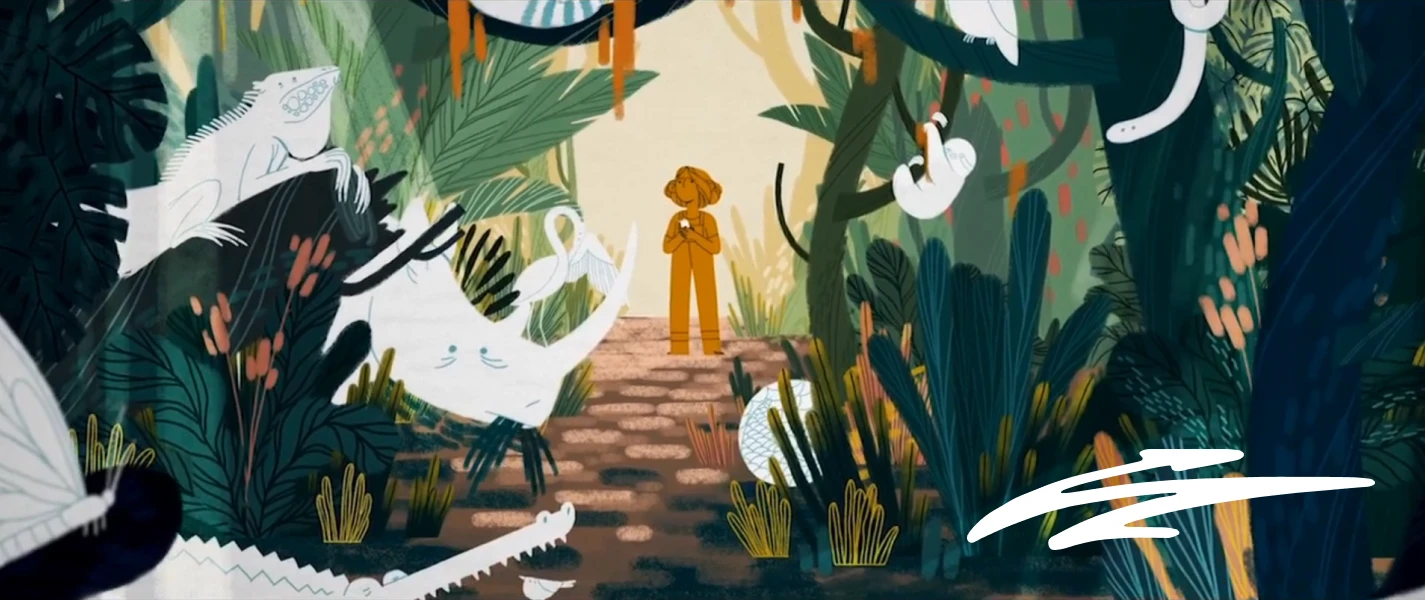

Animation director Simone Giampaolo knows how to strike a balance between creativity and commerce, achieving success in both. His short film Only a Child made it to the Oscar shortlist and was nominated for a BAFTA. Simone's portfolio also includes work for Netflix, Disney, Nickelodeon, Marvel, and BBC.
On September 4th, Simone will give a lecture on the animation pipeline for 2D and 3D as part of the LINOLEUM festival. We met with him beforehand to discuss burnout, the ugly and beautiful in animation, and the guidelines of major studios.
Directors seem to fall into two camps. Some say that being well-versed in visual culture is the key to success, while others don't even read news about new projects in their field. Which camp do you belong to?
I don't think I belong to either camp — I'm somewhere in the middle. I do independent animation and also a lot of commercial content for TV channels, so I need to be aware of what's happening in the industry.
That said, I personally avoid watching big sequels like Despicable Me 4 or Toy Story 5. While they're exciting for the industry and animators, they often recycle the same ideas. I get more inspiration from independent shorts and feature films, both animated and live-action, which bring fresh perspectives in storytelling and aesthetics.
So, while I'd love to be in the camp that doesn't watch anything and just creates, my job requires me to stay updated. I do watch some kids' cartoons and animated features, especially those streaming on platforms like Netflix and Amazon, but I try to focus more on independent content.
Do you draw inspiration from other film genres that might not seem related to animation?
Yes, absolutely. After working in 3D animation for a long time, I often seek to escape its uniformity. My latest short film, Only a Child, for example, combines around 20 different styles, drawing inspiration from stop-motion, sand animation, and traditional oil painting.
In my personal work, whether shorts or ideas for shows, I try to mix as many visual and storytelling styles as possible. I draw ideas from fine art, classical storytelling, and theater. I love musicals and plays for the way they tell stories and showcase acting performances. I observe how professional actors work and try to bring that inspiration into animation.
Do you find classical or contemporary works to be more reliable references for your work?
I love classical art. If I hadn't pursued animation, I might have gone into archaeology, particularly the study of the classics. I studied Latin in school to translate Roman texts and was passionate about Egyptology.
I often draw inspiration from history and past civilizations, particularly classical works. When it comes to the last 100 years, I tend to look at older animated films for inspiration. I rarely use contemporary animation as a reference. Instead, I rely on Disney classics from the 1920s to the 1970s, as well as classical stop-motion films like Pingu, Wallace and Gromit, and early Tim Burton works like The Nightmare Before Christmas.
Does observing the real world help you create more authentic imagery in animation?
Absolutely. It's foundational to animation, especially when it comes to acting. Observing not just movies or plays, but real people — family members, classmates, colleagues — is crucial. Paying attention to how they move, the subtle gestures they make, and their involuntary reactions can make your animation performance more realistic, appealing, and genuine.
I often recommend a book called What Every Body is Saying by Joe Navarro, a former FBI agent who specializes in reading body language and involuntary movements. While you don't need to become an agent, understanding these small nuances in human behavior is key to making your animated characters authentic and believable. I always encourage spending time observing people and getting a bit obsessed with their reactions, acting choices, and the way they speak, sing, or argue.
What do you consider to be aesthetically pleasing, and what do you find visually unappealing?
I'm very much against perfection. As a director of 3D animation, I’m sometimes required to make everything look very polished, clean, and safe — especially in kids' TV or commercial content. But I find that kind of perfection unappealing because it often feels too artificial, like it doesn’t belong to any world — neither real nor fantastic.
I’m drawn to roughness. When I create my own work or sketches, I aim to give them a rough, imperfect feel. For example, I love animation where the lines wobble — what's called the "boiling effect".
One of my favorite examples of this "dirty" animation style is from The Tale of the Princess Kaguya by Studio Ghibli. There's a scene where Princess Kaguya is running away, and as she runs, the animation becomes increasingly sketchy and rough. The line work reflects her state of mind, and I find that absolutely beautiful.
Working in a visual medium like animation can be exhausting. How do you take a break from visual overload?
Everyone gets tired at some point, and I'll admit I'm not great at taking breaks. I often overload myself with projects, moving from commercial work to my own personal projects without much rest.
The best way to recharge is by disconnecting — switching off the phone and spending time in nature, or even just reading a comic book in bed, away from screens and notifications.
Are there any experiences that drain you as an animation director — like a sort of visual noise?
For me, the biggest issues aren't necessarily visual, like poor-quality animation. While watching something grainy due to a bad internet connection isn't ideal, it doesn't bother me as much as two other things.
First, if the acting in a story or movie is off — whether the acting choices are wrong, the characters are uninteresting, or they overact without motivation — it really frustrates me.
Second, story issues, particularly logic gaps, really drain me. I appreciate films with simple stories that don't leave the audience with unanswered questions or distractions from the plot. Logic gaps in a story can ruin the experience for me.
For example, the movie that is beloved by many — Ratatouille. The logic behind the rat controlling the human by pulling his hair has always bothered me. Why should I accept this? It makes no sense to me, and it detracts from what could have been a masterpiece. While everything else in the movie is realistic, this one element feels arbitrary and unexplained.
@mortal_clipss Part 3 / It’s time to cook #chef #movie #ratatouille #fyp #anime #tiktok ♬ original sound - 77-movie🍿
You create independent animation, while also working on commercial projects. Do you need to adapt your visual perspective when switching between these types of projects?
Absolutely. Every client has different boundaries and guidelines. For example, Netflix is usually more flexible and accepting, while Disney or the BBC can be very strict about aesthetics, humor, and language.
I find it particularly challenging when it comes to humor and comedic "violence", especially in kids' animation. For instance, I love the physical humor of Tom and Jerry — the slapstick violence when Tom gets squashed or punched. However, today, it's much harder to include that kind of humor because there are strict rules about not showing kids getting hurt or offended, and even characters in dangerous situations are often off-limits.
For example, I directed a show for Netflix where physical gags were accepted, but now I'm working on a project for another broadcaster, and they are much stricter. They don't allow the main characters to get hurt or fall, so you have to find other ways to make jokes, which aren't always as effective.
When working on personal projects, you have more freedom to experiment. But if you spend too much time on commissioned work, you can get trapped in those restrictive rules and start to lose your creative edge. That's why it's important to keep doing personal work alongside commercial projects to keep your mind open and your imagination free. Otherwise, you risk becoming stuck in a repetitive cycle, doing the same thing over and over for 40 years. I hope to avoid that fate.
What helped you when you started working on commercial projects for big players with established styles?
In my opinion, there’s always a plan B you can pitch to the client. Being quick to adapt, good at selling your ideas, and sometimes putting your ego aside is crucial. Many directors are too proud and want everything done their way. One of the biggest lessons I’ve learned is to set your pride aside, make the change creatively, and move on.
What do you do when you hit a creative block?
I get down. I get a bit depressed. I сry. I'm not great at dealing with creative blocks, to be honest. If I can't find a creative solution for a particular episode, I set it aside for a while.
A day or two later, during a shower or before falling asleep, an idea usually comes to me. I've realized that if you keep banging your head against a wall, the wall gets stronger. So, I prefer to step away for a bit, and almost 95% of the time, I come back with a new solution.
Which contemporary creators do you enjoy following?
There are three creators I really admire. For 3D animation, I always reference the work of Pedro Conti, a modeler and texture artist from Brazil. His work is incredible, and I was lucky enough to collaborate with him on a commercial project for an American company.
Another creator I admire is Olov Burman, animation director from Sweden. His style is unique, with characters that move in completely funny and bonkers ways. As a student, I took a lot of inspiration from his work.
Lastly, there's Leo Ortolani, a comic artist who's not as internationally known but is super famous in Italy. He uses a lot of dark humor in his comics, which I love and often reference.
If you could transform the world into the setting of an animated film, which would you choose? And in what aesthetic environment would you absolutely not want to live?
I would love to live in the world of FernGully. It's such a beautiful film with a strong environmental message. The way the forest is portrayed — magical, vibrant, and full of life — really appeals to me. I recently heard they’re making a 3D remake, which I hate the idea of, much like I hated the 3D remake of The Lion King.
As for an animated environment where I wouldn't want to live, I honestly can’t think of one. Most animated worlds seem better than our real world.