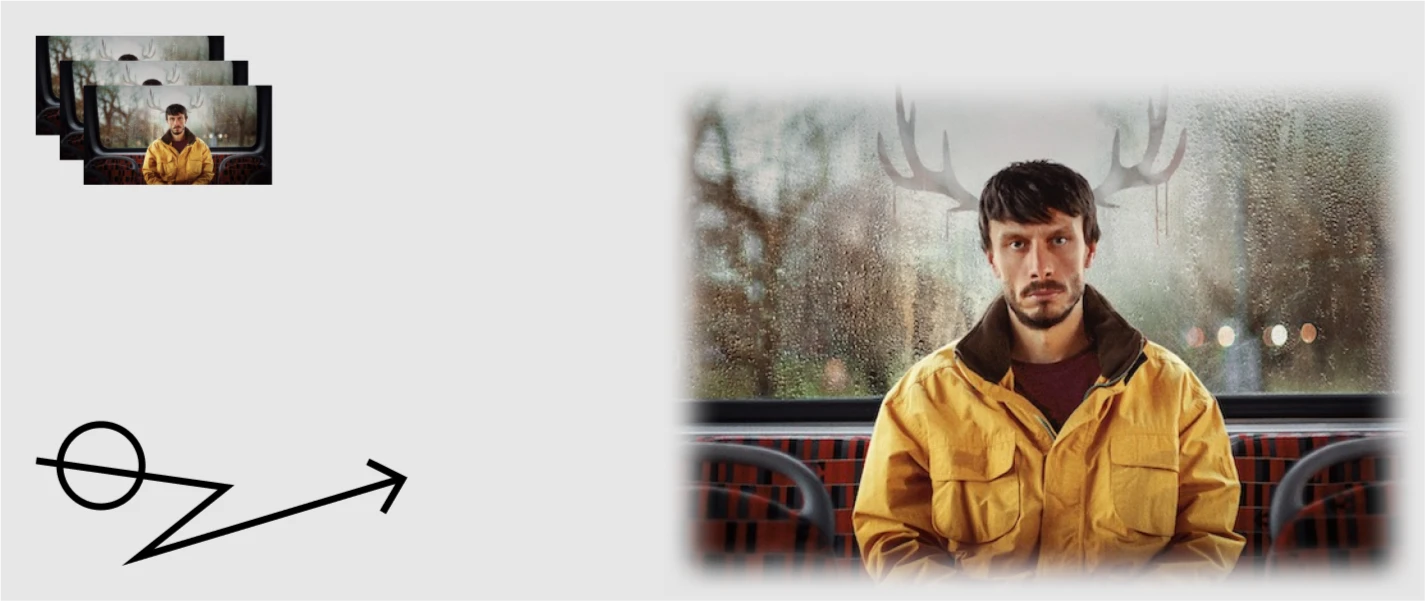

In early April, Netflix premiered seven episodes of the British miniseries Baby Reindeer — and since then, not a day has gone by without discussions about it on Reddit, Twitter, and other media. The entirely true story of a stalker who slowly ruins the life of a stand-up comedian (who is already doing a pretty good job of that himself) has resonated with millions.
Even though the miniseries team tried to conceal the real identities of the characters, “the real Martha” — the stalker of the main character and series creator Richard Gadd — was found quite quickly. The woman has already given several media interviews and attempted to sue Netflix for $170 million.
We binge-watched the series in one night (is there any other way?), and then discussed it with Krzysztof Trojnar, the DOP of the first four episodes of Baby Reindeer. We asked Krzysztof about his background in Polish and British film schools, the specifics of working with Netflix, and what it’s like when half the world is obsessed with a series you make.
You studied at the Krzysztof Kieslowski Film School in Katowice and then at the National Film and Television School in the NFTS. Why did you choose the UK instead of, for example, the USA?
At that time in Poland, after graduating from film school, there wasn't much happening in the country. Mainstream film production and television commercials were well-established, but breaking through required a lot of effort. Looking back, I now see a much more vibrant community with greater opportunities for young filmmakers. However, back then, I felt stuck.
I attended the Camerimage festival and watched a short film from NFTS (National Film and Television School in the UK — ed.). It resonated with me because it was very focused on storytelling. The shorts I watched had strong narratives, which appealed to me. To be honest, that was the primary reason I chose to enrol at NFTS. I also preferred to stay in Europe, and Britain seemed like the perfect fit. As for the USA, I considered AFI, but it was extremely expensive and out of my range.
The world is at the peak of globalization today, yet we still talk about local film languages and traditions. Do you agree that each country has its unique way of making films?
When you're getting into the world of film within your local culture, you can't avoid being influenced by it. But your reaction to that culture can lead to work that isn’t fully immersed in one place. Filmmakers' sensitivities often come from various sources, not necessarily local culture.
For example, with Baby Reindeer, someone on a podcast mentioned we brought an Eastern European harshness to the depiction of the environment. I think it was half-serious, but European cinema definitely has certain motifs that aren't as present in American or UK cinema, making it exciting when these elements mix.
When I went to film school in the UK, I noticed a fascination with Eastern European cinema because it explores themes and aesthetics that might be considered too niche in the West. I remember watching The Tribe (a film by Myroslav Slaboshpytskyi about a boarding school for the deaf — ed.), and the head of the film school was very excited about it. But such films might struggle to get funded in a fully commercial system.
There are definitely things particular to places, but it's interesting to see how these elements travel and convey universal truths through different cultural backgrounds.
So when you moved from Poland to Britain, did you have to adapt professionally — change your mindset, aesthetics, or style?
No, not at all. I don't think I ever thought about it.
Baby Reindeer made a huge impact and continues to do so — small talks now start not with "how are you?" but with "have you seen that series about the stalker?". Did you and your team expect such a response?
No, we didn't expect it to get so wild with the amount of the audience it got. The script felt good when we read it, so we knew we had good material. But we thought it was a niche show and weren't sure if people would be attracted to such a dark story. It was a great surprise to see it blow up.
What does it feel like when half the world is obsessed with a series you made?
Apart from hearing someone talk about it at a bakery in London or seeing people watch it on a plane, life moves forward, and the miniseries has its own life too. It's an amazing feeling to have created something that touched so many people.
That's partly about the power of streaming — it's so easy to access all around the world. It was incredible to realize that this story resonated not just in the UK or America, but also in Asia, Africa, and South America. That was mind-blowing.
You worked on the first four episodes of Baby Reindeer — why not all seven? that works in most productions. While sometimes a director and the DOP handle an entire season, usually the work is divided into blocks. Director and DOP of the first block set the look, tone, and style of the show, and then directors of the following blocks took over.
From the beginning, Baby Reindeer was planned as two blocks. When I joined the project, it was already divided this way. Weronika Tofilska, the director I'd worked with, had picked the first four episodes, with the fourth episode being almost double the length of the previous ones.
Ideally, I’d have loved to do the whole thing, but that would have required more preparation time. When I interviewed for Baby Reindeer at the end of May, I was on board by the first week of June, and we had to start shooting eight weeks later. The production company already had their schedule, so it wasn't possible for us to do the entire series given the prep time we had.
It was purely a practical reason and how the industry often works with TV production. But it was still great to be the first one to establish the style, tone, and visuals of the show with the creator, Richard Gadd.
Later, another DOP joined the project — how does such a transition typically happen on large projects? What did you do to ensure the audience wouldn't notice the change?
In this case, we had a couple of conversations with Josephine, the director, and Annika, the cinematographer of the second block. They saw the dailies of our series because they started prepping while we were still shooting. We presented them with our approach to the project, and they took that on board, adding their own interpretation as well.
There's room for them to explore further as the story evolves. This is typically how we hand over on large projects. I shared some documents with Josephine and Annika that reflected our style and set rules with Weronika, such as central compositions and wide lenses. They made some adjustments to their lens choices, but overall, they continued the story with their own perspective.
What primary goal did you set for yourself as a DOP while working on Baby Reindeer?
I think the primary goal was to tell the story in the best possible way. I listened to the audio recording from the theatre play that Richard did before developing it into a TV show, I read the script, and then tried to create the intense first-person point of view. Through a series of decisions, I aimed to effectively convey Donnie's perspective.
Martha is an intruder in Donnie's world, and we tried to reflect that through the camera's placement and the characters' eye lines. We kept the camera close and sometimes created an uncomfortable closeness.
In Episode 4, we took a more subjective approach, almost seeing everything through Donnie's eyes. For instance, we installed a camera rig on Richard's head for a scene where Donnie runs down the corridor and looks down on his hands, giving a literal POV perspective.
In Baby Reindeer, there were many scenes where the main character is high. It seems that conveying the experience of drug intoxication — believably and without clichés — is challenging. How did you approach this task?
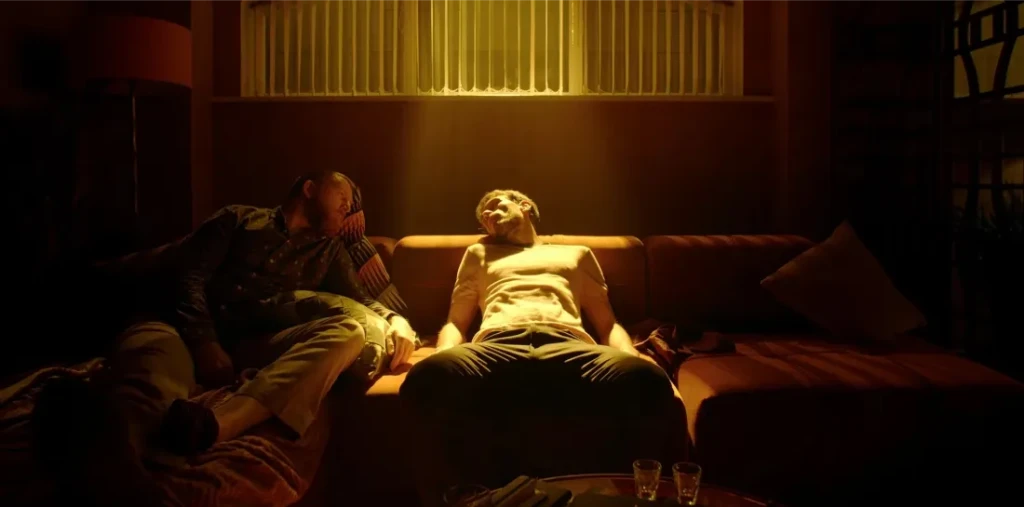
We aimed not to make it overly expressive, but rather stay true to the character. At the same time, we discussed how the influence of drugs can transform reality into something more abstract. For example, in one scene when Donnie is high on the couch, a street light turns into the shape of a spotlight, guided by Donnie's voiceover narrative.
Besides film, you also shoot music videos and commercials — for Adidas, Huawei, FENDI, and other global brands. How does this work differ from working in film, and what do they have in common?
I started my career in commercials, and it's quite different from working in film. The goals and functions are different. But commercials are great for honing craft because you can test different things during shoots, go through various scenarios. I'm drawn to stories based on visual storytelling, and I think it's a completely different language because films usually consist of multiple layers. I really enjoy both worlds, and I think the world of commercials can be equally exciting.
I'm drawn to projects that are visually rich, regardless of whether they are in commercials or film. Ultimately, storytelling is the most interesting part for me. I also enjoy working on projects that aren't necessarily mainstream narratives, like art projects where visuals drive the narrative.
It's great to be able to tell stories that engage the audience psychologically or on an archetypical level. That's the ultimate goal for me, whether I'm working on a commercial or a film.
In Ukraine, filmmakers often work in commerce, but it’s rather a compromise since you can't earn much in film. At the same time, they view commerce sceptically, saying that after a few music videos and ads, you get clip thinking. What do you think of this?
I think these are two different worlds. Sometimes these worlds mix together — many film directors also shoot commercials and still have a strong voice in cinema. I think it's very project-based rather than a general distinction. Commercial projects shot by film directors often add incredible value with their filmmaking skills.
But I understand the problem that you cannot really make a living off indie filmmaking, and I don't think it's just Ukraine. It's a problem worldwide, where projects without a large audience as a starting point find it harder to get funding. And it's sad — I don't know if it was always like this, but it definitely feels the same here in Britain.
What is the most valuable piece of advice you received during your years in film school?
The most valuable piece of advice someone tried to put in my head during my years in film school was definitely about not giving up. As a filmmaker, especially when starting out, it's easy to judge your work based on one project, but in reality, there are millions of reasons why something may not have worked out.
That's something I distinctly remember from film school, especially looking back at my experience in Poland, where there was a lot of negative feedback. If I had stuck to those memories, I don't think I would have progressed.
Which stereotype about commercial videos is false, and which one is true?
I think what is false is the idea that there is a limit to creativity in commercial projects. There are commercials where you can delve into endless creative possibilities. Not always, but it definitely happens.
As for what is true, I'm not so aware of general truths about the industry. I try to focus on doing my thing and not dwell too much on what the industry is like.
What recent Ukrainian film has stood out to you the most?
I really want to watch Pamfir. I've heard so much good about it, and I follow the DOP, Nikita Kuzmenko. We haven't met, but we share a lighting, and camera crew. Somehow, Pamfir skipped my attention — I think it came out when I was shooting Baby Reindeer. But I've seen some excerpts and I think it will probably be one of my favorite Ukrainian films.
Another film that definitely amazed me and has stuck with me for years is The Tribe. It's such an original and powerful story. I think it did very well, and it was definitely talked about here. I remember when it came out, it was an incredible experience. I dream of shooting a project like that in my life.