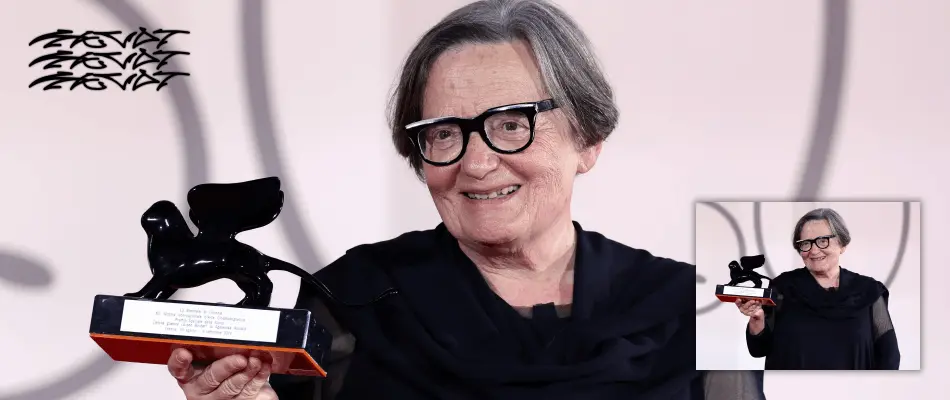

Agnieszka Holland has always worked with white spots in history and made uncomfortable films. Among the movies she worked on are In Darkness, Europa Europa, which won a Golden Globe, Three Colors: Blue, and Angry Harvest. Most of them are dedicated to the crimes of the 20th century.
But The Green Border, her latest film, was an exception. It tells the story of the migration crisis on the Polish-Belarusian border, where refugees from the Middle East try to reach Europe. Critics from around the world have praised the film (the jury of the Venice Film Festival awarded it a special prize), while the Polish government accuses the director of slander and compares The Green Border to Nazi propaganda.
We met with Agnieszka Holland and talked about:
- — political cinema (and whether it can be different)
- — controversial situations at the Berlinale
- — attitudes towards refugees in Poland
- — balancing between reality and storytelling
- — circumstances under which Agnieszka would not have made The Green Border
Jean-Luc Godard said that he wants not only to make political films but to make films politically. How do you interpret his words, and do you set out to make films politically?
I don't completely agree with Jean-Luc Godard. That statement captured the spirit of the time, but as for the rich Swiss guy, it didn’t feel authentic. I also don't like his films from the 1970s and 80s, which are the ones Godard's words refer to. These movies resemble Soviet propagandistic cinema. For me, his early films are much more political — they are anarchistic, provocative, and inspiring.
Everything in the world is, to some extent, political. Especially when you step out of your bubble and enter the realm of your own interests. Because politics doesn't only happen in parliamentary buildings. You must somehow engage with politics to understand the world, its challenges, and dangers. That's why a director should step out of their comfort zone. All courageous cinema is political to me. However, films about politics can be timid — conformist.
You often emphasize the lack of bold cinema in the world. What does bold cinema mean to you – regardless of genre and theme?
Shining a light on controversial topics is bold. Considering that it's challenging to find money for such films. When you approach a streaming platform and propose a "controversial" theme (in fact, all of the essential subjects are controversial — even love, for example, in the case of homosexual relationships), you get rejected. They think, "Okay, we have a polarized audience, so if we do something controversial, we automatically lose half of our viewers." They don't see the point of investing in political, controversial, or painful stories under such circumstances. Streaming platforms prefer to invest in crime stories or romantic comedies — everyone will watch them.
Government institutions, grant programs, and funds all have their own agendas, aesthetic or political. They influence the decisions of directors.
The Berlin Film Festival recently concluded. The main prize went to a documentary film directed by a Palestinian-Israeli duo. From the stage, they called for a cease-fire — this is controversial and doesn't align with Israel's current politics in Gaza. Immediately after that, the mayor of Berlin verbally attacked the festival. He said that speaking out against Israel's politics is a manifestation of antisemitism, so he won't allow people to say something similar from the stage next time. This is blatant censorship.
Another "controversial" topic is Ukrainians' attitude towards Russians. I'm not talking about war, but about cancelling Russians and everything Russian – many don't see the sense in this. As the president of the European Film Academy, I went through several fights with my colleagues about this. I tried to argue that Russia is an imperialistic and brutal aggressor. Russian filmmakers make movies with the money of the state and oligarchs, and we can't impose sanctions against Russia while celebrating their cinema at the same time. But, you know, many people can't accept this. They say artists are beyond politics and so on.
We live in a world filled with controversial topics, but that doesn't mean we should avoid them. On the contrary, I believe we must speak on these topics and make films about them, even if it's uncomfortable and difficult.
You started working on the Green Border in 2021, a year before the full-scale war in Ukraine. How did you envision the ending of the story then, and how much did the Russian invasion of Ukraine influence the screenplay?
We wrote an extended version of the script at the end of 2021. Then, in February 2022, the full-scale war began. At that time, I was in Poland, and it was such a shock. People began going to the border, assisting Ukrainians in big cities, sharing their apartments with refugees, etc. Poles were doing good, truly sacrificing their comfort to help people. And not just dozens or hundreds of people but millions. We felt great — we loved our generosity.
So, I thought adding an epilogue and showcasing this potential would be right. The war in Ukraine proved that a person is capable of both good and evil, solidarity, and racism. But regardless of skin color, refugees experience the same despair and fear and have the same hopes.
Why, in the final scenes, do Polish activists move to the Ukrainian border instead of staying at the border with Belarus? It seems that the spring of 2022 was an ideal time to help migrants from the Middle East, as border authorities' attention was focused on Ukraine.
Yes, that's true. However, these activists were highly competent. They had experience working in refugee camps abroad and knew how they were organized. So, they felt their competence would be beneficial when tens of hundreds of people crossed the border daily. In most cases, volunteers, not the state, provided assistance to Ukrainians. When the crisis at the Polish-Ukrainian border became less extensive, activists returned to the border with Belarus.
In previous interviews, you mentioned the lack of films addressing current dangers rather than issues from 30 years ago. Please tell us about the difference in working with history, archives, and current events, which will also become part of history over time.
Talking about history is less risky because you know exactly how it ended. You have the overview, the distance. When you work with a current issue, you are driven by the dynamics of daily changes. Today, the world is moving so fast, with so much information and events that it is tough to grasp and make an overview.
That's why most don't even attempt to make films about what's happening right now. But I felt that the situation at the Polish-Belarusian border concerns the entire world. The migration crisis will be one of the biggest global challenges. And this crisis will impact who we are as Europeans — white, rich, privileged people.
I also sense that the patterns we use today are becoming similar to past narratives. We haven't formed a new ideology. Even Putin doesn't have one — he overuses Stalinist patterns. We're returning to the worst part of the 20th century. I've made four films about crimes against humanity committed in the first half of the 20th century, so I can recognize this. And I see the possibility of coming back. Full-scale wars, bombings of civilians, rape of women, kidnapping of children — we never thought this could become possible again.
You mentioned that despite government threats, discussing the film with Polish audiences seemed like collective psychotherapy. How did the Polish people you spoke to at screenings react to your movie? Did you observe openness to a dialogue about the migration crisis?
Absolutely. After the release of The Green Border, I received so many letters and messages like never before. Most people I spoke to after screenings were willing to discuss the migration crisis. They were seeking a compromise between humanitarianism and the political necessity of ensuring border security. They felt divided inside, so I speak of the film's psychotherapeutic effect.
My goal was to convey the voices of the voiceless, the faces of the faceless. And Poles wanted to see it from that perspective because they were sick of talking about geopolitics and the bad Lukashenko. They wanted to understand the perspective of refugees who don't care who facilitates their passage to paradise — even if it's a dictator or the mafia. They just want to flee the war and live in a safe place where dignity is possible, where they can send their children to school. Their perspective is very narrow but also very authentic. Our perspective is fear, propaganda, security, and comfort (mostly comfort).
When I talked about refugees on social media before filming the movie, most people wrote to me: "Then take them into your home if you're so generous." Not much time passed, and Ukrainian refugees lived in all three of my houses. This experience wasn't always nice. Some brought mess, and some became my friends. You can't conduct a casting call for refugees. But it seemed to me that opening the doors of my home to refugees was so natural. Not only did I feel that way, but many people in Poland did, too. So, I believe the Ukrainian experience was a great lesson for us. Many Poles later found it difficult to look back and see that they treated Ukrainians well while treating dark-skinned refugees from the East poorly. They won't admit to being racists. Therefore, discussions about the migration crisis deeply touched our worldview.
When the migration crisis began in Poland, Jarosław Kaczyński closed media access to the Polish-Belarusian border. You mentioned that you created The Green Border to replace all the nonexistent journalistic materials. In that case, why did you make a feature film instead of a documentary format?
I know how to make fictional films, but not documentaries. Additionally, some of my colleagues have started making documentaries on this topic. Some of them are currently in the final stages. However, they didn't have access to the most dramatic and painful events because cameras were not allowed in the places where they occurred. Kaczyński said that the Americans lost the Vietnam War because they allowed the media to be there. He didn't want the Polish and European community to see beaten people and children in the swamps at the border. So, I decided to create these images based on real statements, photos, and videos, sometimes taken by border guards. By making feature films, I reach a much wider audience.
How did you minimize the distance between reality and the final movie? As they tend to diverge at each stage of the filmmaking process.
I tried to make the film as objective as possible and show events from the perspective of refugees, but also the activists and border guards. Therefore, I was open to fulfilling the script if needed, particularly with the experience of real activists who played minor roles in the film. They passed it to the actors who played major activists roles. Refugee actors — all those who played migrants had such experience in real life.
So, we tried to stay as close to reality as possible while considering storytelling. The movie lasts 2.5 hours, and we wanted to ensure that people would stay until the end — for that, it was crucial to hold their attention. I believe we succeeded. I saw people entering the cinema with buckets of popcorn and leaving with the same full buckets — they couldn't eat during the screening. This proves that people were taken by the story.
Besides the migration crisis, what other political issues still need to be illuminated in European cinema?
We lack films depicting the political events in the Western world. It is also essential to film about the war in Ukraine, considering the many factors influencing it, such as decisions made by the Senate regarding funding and Hungary blocking Ukraine's EU accession, among others. These factors have real-life consequences for Ukrainian soldiers, and telling these stories is crucial. While we may not have access to all sources, we have enough knowledge and imagination to create films. The Israel-Gaza conflict is another hot topic. And, of course, the migration crisis. My movie is one of several addressing this issue, although the theme is much broader.
In Ukraine, there is criticism of making feature films about war, as the processing of trauma can only occur when the traumatic experience concludes.
This is very subjective. Someone is able to film about an ongoing traumatic experience, while another person deeply immersed in that trauma may find it challenging. I recall how my filmmaker friends documented the war in Yugoslavia and the siege of Sarajevo during those events. They felt less powerless and more useful.
I have seen several great Ukrainian films made after 2014. People are used to not connecting with images in the news, but narrative and documentary films provide an opportunity to establish a real connection. Therefore, I believe that filmmakers must convey this experience. However, perhaps some distance is indeed necessary. I'm not sure if I could have made The Green Border if I were a Syrian refugee in the woods. I had the luxury of observing these events from the outside. I wasn't personally traumatized by them, so I had some distance.